Your checkout is a chain of other people's systems: a cloud region, a DNS provider, a CDN, a payment gateway, an identity provider, a tax API, an email service. At peak you inherit every one of their bad days, and you cannot fix their outage. What you can do is decide, in advance and in writing, what your product does when each link breaks. That decision is the difference between an outage and a degraded hour.
Holiday Readiness series, part 2 of 8. Not sure where to start? Take the free Holiday Readiness Assessment and get a prioritized checklist by email.
Direct Answer
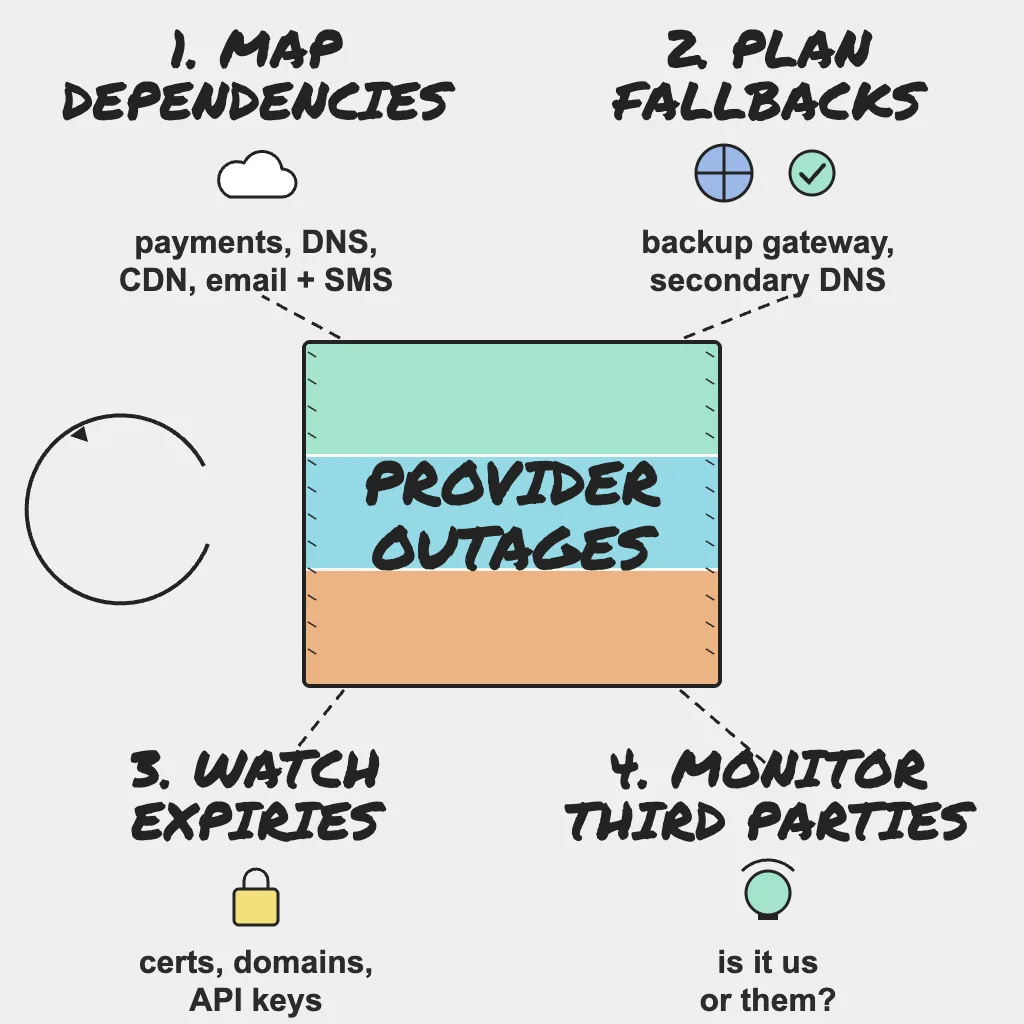
- Map every third-party dependency on your revenue paths, including the ones hidden inside other dependencies.
- For each one, write down what happens to checkout if it fails or slows down.
- Build and test fallbacks for the critical ones, such as a backup payment provider and secondary DNS, before the freeze.
- Monitor providers from the outside, on the endpoints your code actually calls.
- Renew every certificate, domain, API key, license and payment credential that expires before January.
Why This Matters
Providers see the same peak you do, multiplied across all their customers, so their busiest week is also yours. Their failures are also the slowest to diagnose: your servers look healthy, dashboards are green, and customers still cannot pay. Without a dependency map and external checks, teams burn the opening of an incident proving it is not their code.
Most mitigations here (a second payment provider, secondary DNS, a replacement credential) need contracts, approvals or propagation time. They cannot be improvised during a freeze.
Map Every Dependency
Build the inventory
Start from the customer journey, not the architecture diagram. Walk through login, search, cart, checkout, payment and confirmation, and list every external service each step touches:
- Cloud: region, managed databases, queues, object storage.
- DNS: authoritative provider for every domain, plus the registrar.
- CDN and edge: caching, WAF, bot protection.
- Payments: gateway, fraud screening, wallets, 3-D Secure.
- Identity: identity provider, social login, SSO for business customers.
- Messaging: transactional email and SMS, including one-time passcodes.
- Commerce APIs: shipping, tax, address validation.
- Browser scripts: analytics, tag managers, chat widgets.
Then look for hidden layers: a fallback that shares a cloud region or DNS provider with your primary can fail in the same outage.
Find the seams
Hybrid estates (cloud, data center and SaaS) multiply failure modes, and most live at the seams: VPN tunnels, private links, webhook receivers, IP allowlists. Mark each seam on the map.
Field note: The outage that hurts most rarely lives inside a component. It lives at a seam between two teams or two providers, where each side assumed the other was watching, so put an owner's name on every line that crosses a boundary.
Decide What Checkout Does When X Fails
Each line on the map needs a decision attached:
| If this fails | Typical impact | Possible fallback |
|---|---|---|
| Payment gateway | Checkout stops | Backup provider; keep cart and retry |
| DNS provider | Site unreachable | Secondary DNS already serving the zone |
| CDN | Slow or failing pages | Origin bypass, if origin can take the load |
| Identity provider | No new logins | Guest checkout; existing sessions keep working |
| Email or SMS | No confirmations or passcodes | Queue and retry; secondary passcode route |
| Shipping or tax API | Checkout blocked on a quote | Cached rates or a flat-rate fallback |
| Cloud region | Partial or full outage | Planned failover, or status page and wait |
Slow is worse than down
A provider that returns errors fails fast. A provider that hangs holds threads, connections and customers hostage. Every outbound call on a revenue path needs a timeout, bounded retries with backoff, and a circuit breaker. Move anything that need not be synchronous (confirmation emails, analytics events, order exports) onto a queue, so a slow provider delays a message, not a sale.
Fallbacks are product decisions
Accepting orders with estimated tax, or allowing guest checkout while the identity provider is down, is a business call. Product should make it now, document it in the runbook, and name who can trigger it during an incident.
Build Fallbacks You Have Actually Tested
A fallback you have never exercised is a hope.
- Backup payment provider. Contract signed, credentials live, fraud rules and reconciliation in place. Route a small share of real traffic through it before the freeze.
- Secondary DNS. Serve your zones from two providers, keep records in sync, and list both providers' name servers at the registrar. Do it well before the freeze, because DNS changes are slow to apply and slow to undo.
- CDN bypass. Load test origin without the cache first. It may not survive what the CDN was absorbing.
- Regional failover. Decide which region failure you will survive and which you will ride out with a status page, then rehearse the one you will survive.
Every API key, webhook and identity integration is also a trust boundary, and peak season is when they are probed hardest: credential stuffing on login, card testing on payment endpoints. Confirm bot protection and rate limits on those paths, and make sure your backup payment provider has equivalent fraud controls.
Monitor Providers From the Outside
Vendor status pages are context, not detection: they often lag what customers see and describe the provider's view, not your integration. Subscribe to them, then build your own signal:
- Check the provider endpoints your code calls, from multiple regions, with a lightweight authenticated request where the API allows it.
- Run a multi-step check through checkout and payment to catch failures that only appear end to end.
- Monitor DNS records for your domains so unexpected changes surface quickly.
- Put heartbeats on jobs that depend on providers, such as order exports to a shipping partner or payment reconciliation.
PingAlert covers this list with uptime checks from multiple regions (confirmed before alerting), multi-step checks, DNS checks and heartbeat monitors for cron jobs. Comparing your own endpoints with the provider's tells you quickly whether the problem is yours or theirs.
Audit Everything That Expires
Expired credentials cause some of the most avoidable outages there are. List everything that expires before January:
- SSL certificates on API endpoints, webhook receivers and internal services, not just the storefront.
- Domains, including secondary ones used for email, CDN or marketing links.
- API keys, OAuth client secrets and SSO signing certificates.
- Licenses and vendor plan renewals.
- Payment credentials, merchant certificates, and the company card that pays critical vendors.
Renew early, record the owner and the steps, and turn on SSL and domain expiry monitoring so warnings arrive weeks ahead.
Field note: An expired credential at peak is never just an expiry problem. It is a rotation procedure nobody has run in a year, executed under pressure by whoever is on call, so rotate the risky ones now, while the person who knows how is still at their desk.
Who Owns What
- SRE: External monitoring of providers and checkout, vendor status subscriptions, and provider-failure runbooks.
- DevOps: Keys, secrets and certificate renewal in pipelines, and shipping fallback configuration before the freeze.
- Platform: The dependency register, secondary DNS, CDN bypass, regional failover, timeouts and circuit breakers in shared clients, and the expiry audit.
- Product: Fallback behavior per provider, backup provider contracts and cost, and who can trigger a business-impacting fallback.
Practical Checklist
- Walk the customer journey and list every external dependency, including browser scripts.
- Find shared hidden dependencies and seams, and give each an owner.
- Write "what happens to checkout if X fails" for every provider.
- Add timeouts, bounded retries and circuit breakers on revenue paths, and queue non-essential calls.
- Get product sign-off on fallback behavior and who can trigger it.
- Test a backup payment provider with real traffic before the freeze.
- Serve DNS from a secondary provider listed at the registrar.
- Confirm bot protection and rate limits on login and payment endpoints.
- Monitor provider endpoints and checkout from outside, and subscribe to vendor status pages.
- Renew every certificate, domain, key, license and payment credential expiring before January.
Reader Questions, Answered
How do we monitor a third-party service we do not control?
Check the endpoints your code calls from multiple regions, and run a multi-step check through the journey that uses the provider. Treat the vendor's status page as context, not your alert.
Do we really need a backup payment provider?
If a gateway outage would stop all sales, a tested backup is usually worth it. Product should weigh the contract and integration effort against a checkout outage at peak.
Is it safe to set up secondary DNS right before Black Friday?
Not ideally. DNS changes are slow to propagate and slow to undo, so set it up before the freeze and watch it through a normal traffic cycle.
What expires most often without anyone noticing?
Certificates on APIs and internal services, secondary domains, SSO signing certificates and the card on vendor accounts, because they sit outside storefront checks.
Wrap Up
You will not prevent a provider's outage. You can decide, ahead of time, whether it costs you an hour of revenue or an hour of slightly degraded checkout. Map the chain, test the fallbacks, and renew what expires. Take the Holiday Readiness Assessment to see how ready your dependencies are.
Holiday Readiness Series
- The peak-season reliability playbook
- When third-party providers fail at peak (you are here)
- Capacity: quotas, connection limits and rate limits
- Change freeze and release safety
- Holiday website monitoring checklist
- On-call, runbooks and incident communication
- Unexpected traffic: load testing and graceful degradation
- After the peak: post-incident reviews
Previous: The peak-season reliability playbook · Next: Capacity: quotas, connection limits and rate limits
Related guides:
- Website and API uptime monitoring: what to monitor first
- How synthetic monitoring helps and why it is important
- Q2 2026 reliability report: outage lessons
Sources and references
- This post is based on PingAlert's holiday readiness checklist and holiday website monitoring guidance.
- Google SRE Book: Addressing Cascading Failures