StatusCake has been a common answer to "what do agencies use for uptime?" for a long time, and for good reasons: white-label reporting, domain and SSL checks, page speed tests and a large location network. When agencies start looking for an alternative, it is rarely about whether checks run. It is about how clients are separated, where status pages live, and whether the contract matches the way the agency sells monitoring.
This guide compares StatusCake and PingAlert on those agency questions. Every StatusCake fact below comes from StatusCake's own pricing, product, knowledge base and terms pages in November 2026, linked at the end.
Direct Answer
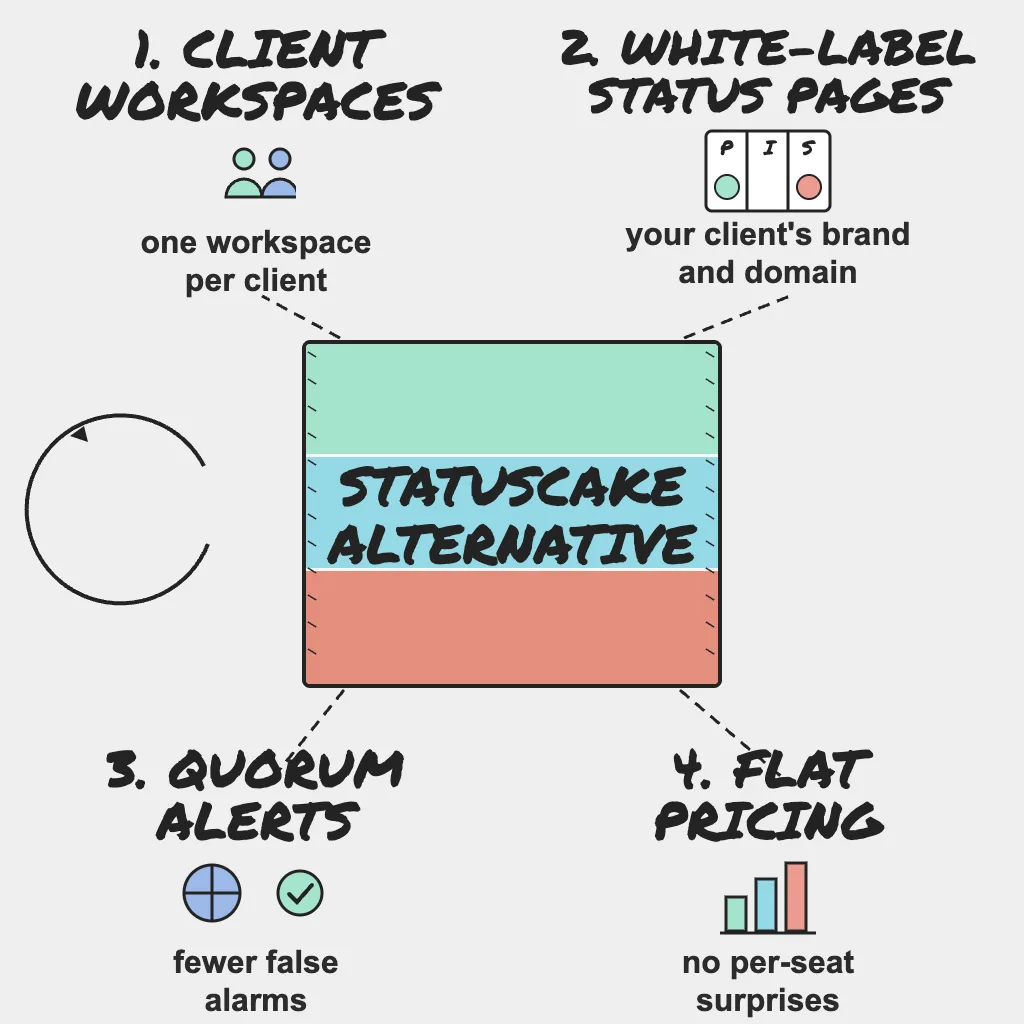
Stay with StatusCake if white-label reporting, domain expiry, page speed and server monitoring are central to your client deliverables. Consider PingAlert if you want each client in a separate workspace with its own monitors, alerts, incidents and status page, white-label status pages with custom domains included in paid plans, quorum-confirmed alerts across regions, and multi-step API checks for client apps.
Why This Matters
An agency's monitoring setup is really three products: detection for your team, communication for your clients, and evidence for your account reviews. Tools often split those across plans or separate products, which is fine until you need to price a retainer. Knowing exactly which plan unlocks client-facing features, and what the terms say about monitoring sites on a client's behalf, saves an awkward conversation later.
What StatusCake Does Well
- Reporting for clients: As listed on StatusCake's pricing page in November 2026, Unbranded Reporting and White Label Reporting are available on the Superior and Business plans.
- Broad check types: Uptime, page speed, domain (with expiration alerts, blacklist and record monitoring), SSL (with expiration and mixed content alerts) and server monitors.
- Clear plan ladder: As listed on StatusCake's pricing page in November 2026, Free is $0 with 10 uptime monitors at a 5-minute interval. Superior is $24.49 per month on monthly billing ($20.41 per month billed annually) with 100 uptime monitors at a 1-minute interval. Business is $79.99 per month ($66.66 per month billed annually) with 300 uptime monitors at a 30-second interval. Every plan has a 7-day free trial with no credit card required.
- Location choice: StatusCake's locations page describes monitoring from 43 locations in 30 countries, and custom locations are listed on Superior and Business.
- Team access by tag: StatusCake's sub-accounts article describes Read or Read and Write access and restricting a user to tests with specific tags. The pricing page lists 1 team member on Superior and 9 on Business, with audit log, custom template emails and dashboards on Business.
- Many alert integrations: The integrations page lists Slack, Microsoft Teams, Discord, PagerDuty, OpsGenie, webhooks, phone call and SMS, Telegram, Mattermost, Datadog and more.
Status Pages Are a Separate Product
StatusCake Pages has its own plans. As listed on StatusCake's status page product page in November 2026, Bronze is $14.95 per month on monthly billing ($12.46 billed annually) for 1 page and 300 subscribers, Silver is $49.95 ($41.63) for 5 pages and 1,500 subscribers, and Gold is $249.96 ($208.29) for 10 pages and 7,000 subscribers. The "No Branding" option is listed on Silver and Gold. Subscribers can sign up for email, text messages or RSS.
That is a reasonable model for a single company. For an agency, it means budgeting status pages separately from monitoring and checking how page counts line up with client counts.
Read the Authorized-Use and Resale Clauses
StatusCake's terms and conditions (last updated 14 March 2022) are worth reading before you build a client offering. Clause 10 says: "You may only use the StatusCake and the StatusCake Service for monitoring websites owned and/or controlled by you." It defines third party websites as those you do not own or control "and where you do not have prior written permission from the website owner to monitor their website." The same clause states: "The StatusCake Service is for your own use only and you may not, without our prior written consent (which we may withhold in our absolute discretion), allow any third party to use the StatusCake Service, re-sell or otherwise offer for sale the StatusCake Service."
To be fair, clause 3 also describes a reseller arrangement in which StatusCake "may allow a reseller" to purchase a yearly plan where the ultimate beneficiary is an "End Customer," and the StatusCake site links "MSPs and resellers" to these terms. The practical takeaway applies to any tool: get written monitoring permission into every client contract, and talk to the vendor if you plan to resell.
Field note: Terms of service are part of your architecture. Read the authorized-use and resale clauses the way you would read a cloud quota: they are limits you agreed to whether or not anyone on the team read them.
Agency Comparison at a Glance
| Capability | StatusCake | PingAlert |
|---|---|---|
| Separate client spaces | Tag-restricted team access | Client workspaces (3 on Professional, 10 on Business) |
| White-label client reports | Superior and Business | Not listed (status pages and incident history) |
| Status pages | Separate StatusCake Pages plans | Included in paid plans |
| Remove branding on status pages | Silver and Gold Pages plans | Paid plans, with custom domains |
| Fastest listed check interval | 30 seconds (Business) | About 30 seconds (Professional, Business) |
| Monitoring locations | 43 locations in 30 countries | 3, 5 or 10 regions by plan |
| Slack, Teams and webhooks | Yes | Yes |
| Domain expiry and page speed | Yes | No |
| Multi-step API checks | Not listed | Yes |
Where PingAlert Fits Agencies Differently
- Client workspaces: Monitors, alerts, incidents and status pages are separated per client under one subscription, with a portfolio view of client health and active incidents. The agencies page shows the layout.
- Status pages in the same plan: White-label status pages with custom domains on paid plans, subscriber notifications, incident timelines and incident templates, connected to the same monitors that detect the problem.
- Confirmed, routed alerts: Multi-region checks with quorum-based confirmation, deduplicated notifications, escalation policies, quiet hours and maintenance windows, delivered to Slack, Microsoft Teams, Discord, email, SMS or webhooks.
- Checks for client apps: HTTP, keyword, API checks with methods, headers and bodies, multi-step API checks for login and checkout flows, SSL, DNS, TCP, ping and heartbeat monitors.
- Onboarding speed: Monitor templates give each new client the same baseline.
- Flat tiers: Starter $29 per month (25 monitors, 2-minute checks, 3 regions, 1 branded status page), Professional $79 (75 monitors, about 30-second checks, 5 regions, 3 client workspaces) and Business $249 (300 monitors, about 30-second checks, 10 regions, 10 client workspaces). See pricing.
When to Stay with StatusCake
- Branded reports are a client deliverable. StatusCake lists white-label reporting on Superior and Business; PingAlert does not list branded reports.
- You sell domain, page speed or server monitoring. StatusCake includes all three. PingAlert does not monitor domain expiry or page speed.
- You need many locations. If clients ask for checks from specific countries or cities, StatusCake's location network is broad.
- Tag-based access already works. If your team is small and clients never log in, tags may be all the separation you need.
How to Switch Without a Monitoring Gap
Write each client's requirements down first. The free uptime monitoring requirements checklist gives you a consistent baseline to migrate against.
- Export your monitors. List every test with its URL, type, interval, locations, tags and contact groups, using StatusCake's API or dashboard, and group tests by client tag.
- Recreate checks per client. Create one PingAlert workspace per client, apply a monitor template, then add the specifics. Keep a separate plan for any domain expiry or page speed checks you still need.
- Map alert channels. Translate contact groups into per-client Slack or Teams channels, email, SMS and webhooks, then add escalation policies and quiet hours.
- Rebuild status pages. Recreate components and branding per client, import subscribers where possible, and stage the custom domain change.
- Run both in parallel for a week. Compare every alert, resolve any gaps, then move status page domains and retire the old tests.
Reader Questions, Answered
Is StatusCake good for agencies?
Yes. Its pricing page lists white-label reporting on Superior and Business, and its domain, SSL and page speed checks suit agencies that report on site health broadly.
Do StatusCake plans include status pages?
StatusCake Pages is listed with its own plans (Bronze, Silver and Gold) on its status page product page, separate from the monitoring plans on its pricing page.
Do I need client permission to monitor their sites?
StatusCake's terms require that monitored sites are owned or controlled by you, or that you have the owner's prior written permission. Putting written permission in every client contract is good practice with any tool.
Does PingAlert offer white-label reports?
PingAlert does not list branded reports. Clients get white-label status pages with incident history and timelines, and your team gets a portfolio view across workspaces.
Wrap Up
StatusCake is a solid, long-standing tool, and if branded reports and domain checks are what you sell, it still fits. If your agency is moving toward client workspaces, status pages that live with the monitors, and plans that are simple to price into retainers, compare tiers on pricing and start with the requirements checklist.
Related guides: