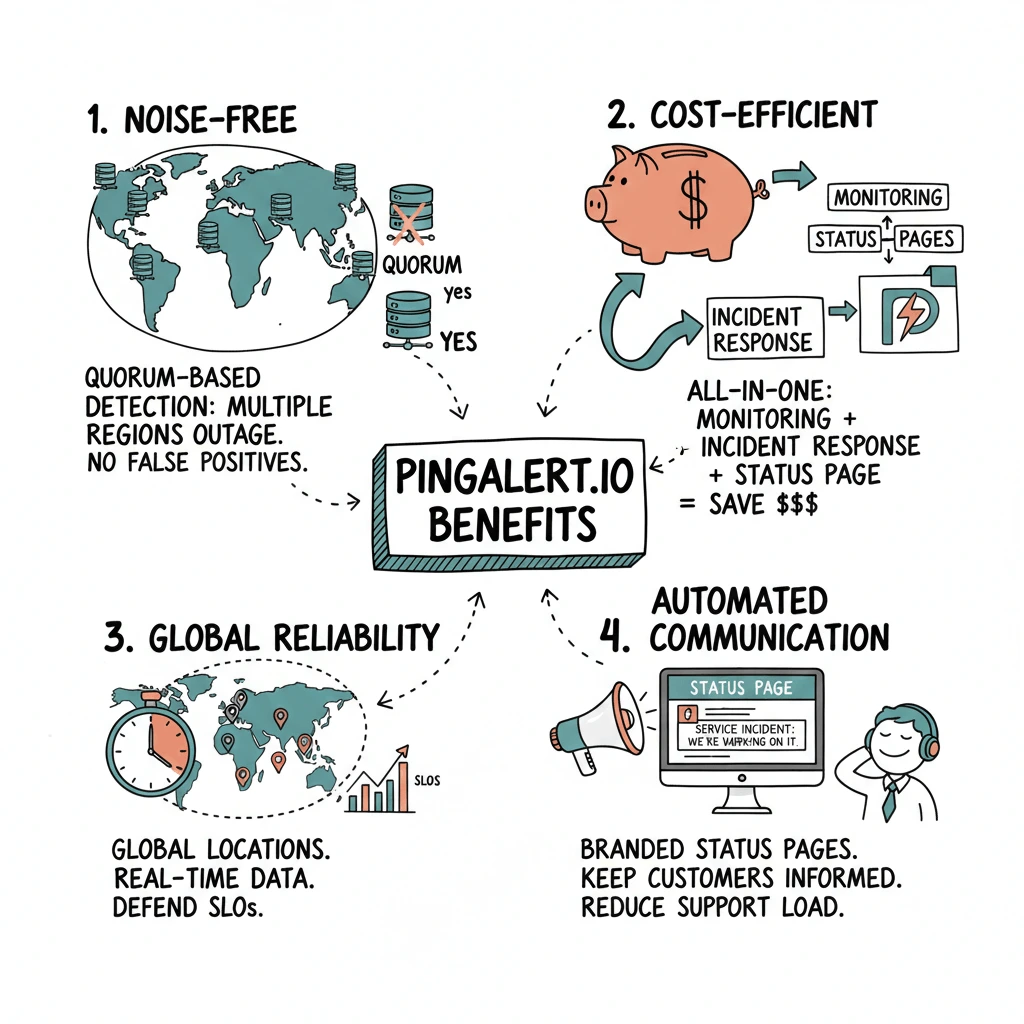
Choosing an uptime monitoring platform is no longer just a question of whether it can ping a URL and send an alert. Modern teams need monitoring, useful alerting, incident coordination, status pages, and customer communication to work together during real incidents.
This comparison looks at PingAlert vs UptimeRobot vs Better Stack vs Pulsetic using the reliability workflow criteria that matter most to DevOps, SRE, SaaS, MSP, and agency teams.
Direct Answer
If you want the simplest low-cost uptime checks, choose UptimeRobot. If you need broad logs, tracing, and observability depth, choose Better Stack. If you want a clean and streamlined monitoring experience, consider Pulsetic. If your team wants uptime monitoring, incident management, alerting, status pages, and client communication connected in one workflow, PingAlert is the most balanced choice.
Why This Comparison Matters
Monitoring is not just about detecting downtime anymore.
Teams now need five things to happen quickly when something breaks:
- Detect the issue before customers report it.
- Send alerts that are relevant instead of noisy.
- Coordinate incident response without losing context.
- Publish status updates customers can trust.
- Reduce tool switching during high-pressure incidents.
That last point is where many uptime monitoring stacks break down. A team may use one tool for checks, another for alerts, another for incident notes, and another for public communication. During an outage, switching between those tools slows down response and increases the chance of delayed customer updates.
Quick Comparison
| Platform | Strongest fit | Main strength | Trade-off to consider |
|---|---|---|---|
| PingAlert | Teams that want a complete reliability workflow | Monitoring, alerting, incident response, status pages, and client communication in one place | More focused on uptime operations than broad infrastructure observability |
| UptimeRobot | Startups and small teams that need straightforward monitoring | Easy setup, budget-friendly uptime checks | Less complete for incident communication and customer workflow management |
| Better Stack | Engineering teams that need deep operational visibility | Logs, tracing, monitoring, and observability features | Can be broader than needed if your main problem is uptime response and communication |
| Pulsetic | Teams that want a modern monitoring experience | Clean interface and simple incident tracking | May not cover the full reliability communication workflow some teams need |
Key Takeaway
Every platform has a valid use case:
- UptimeRobot is best when simplicity and affordability matter most.
- Better Stack is best when deep observability and engineering visibility matter most.
- Pulsetic is best when a clean, streamlined monitoring experience matters most.
- PingAlert is best when monitoring, incident response, and customer communication need to work together.
The important question is not "which uptime monitor has checks?" The better question is: which platform helps your team move from alert to action to customer update with the least friction?
UptimeRobot: Best for Simple and Affordable Monitoring
UptimeRobot is often a good fit for teams that want fast setup and reliable uptime checks without much operational complexity.
Its strengths are clear:
- Easy to set up.
- Budget-friendly.
- Reliable uptime checks.
- Useful for small teams and early-stage projects.
Choose UptimeRobot when you mainly need straightforward website monitoring and basic notifications. It works well when your team does not need a deep incident workflow or client-facing communication process inside the same platform.
The limitation is that simple detection is only the first step. Once incidents require coordination, customer updates, and alert-noise control, teams often need more workflow support around the monitor itself.
Better Stack: Best for Deep Observability
Better Stack is strong when teams want a broader observability ecosystem. It is a good option for engineering organizations that care about logs, tracing, monitoring, and operational visibility in one environment.
Its strengths include:
- Advanced observability capabilities.
- Logs, tracing, and monitoring in one ecosystem.
- Powerful visibility for engineering teams.
- A strong fit for organizations with deeper operational needs.
Choose Better Stack when your main requirement is broad observability across engineering systems. If you need to investigate application behavior, infrastructure context, and logs alongside uptime signals, that depth can be valuable.
The trade-off is focus. If your immediate problem is not deep observability but faster uptime response, fewer alerts, and clearer customer communication, a more focused reliability workflow may be easier for the team to adopt.
Pulsetic: Best for a Clean Monitoring Experience
Pulsetic stands out for teams that want a modern and streamlined monitoring platform without excessive complexity.
Its strengths include:
- Clean user interface.
- Simple monitoring experience.
- Easy incident tracking.
- A modern workflow for teams that prefer lightweight tools.
Choose Pulsetic when usability and simplicity are high priorities and your team wants a cleaner monitoring experience than traditional uptime tools.
The trade-off is workflow breadth. If your team needs monitoring, incident communication, status pages, alerting, and client communication tightly connected, evaluate whether a simpler monitoring experience is enough during real incidents.
PingAlert: Best for a Complete Reliability Workflow
PingAlert is designed around the reality that downtime response is a workflow, not a single alert.
What stands out is that PingAlert connects:
- Monitoring.
- Alerting.
- Incident management.
- Status pages.
- Client and customer communication.
That means teams do not need to jump between multiple tools during an incident. Detection, response, and communication stay closer together.
This matters because many teams struggle with the same operational problems:
- Alert fatigue.
- Tool switching.
- Slow incident communication.
- Delayed customer updates.
After speaking with many SRE and DevOps engineers, one concern comes up repeatedly: teams do not want more alerts; they want smarter alerts with better context. PingAlert focuses on fewer alerts, better context, and faster action.
Why Alert Fatigue Should Influence Your Platform Choice
Alert fatigue is not just an annoyance. It directly affects response quality.
When teams receive too many low-value notifications, three things happen:
- Important alerts become easier to miss.
- Engineers lose trust in the monitoring system.
- Incidents take longer to acknowledge and communicate.
That is why the best uptime monitoring platform is not always the one with the most alert channels or the longest feature list. It is the one that helps teams understand which issues actually need action.
For many modern teams, the winning workflow is:
- Detect meaningful downtime.
- Reduce duplicate or noisy notifications.
- Give responders enough context to act.
- Publish customer-facing updates quickly.
- Keep the incident timeline clear for follow-up.
PingAlert is built around that full loop.
Which Platform Should You Choose?
Choose UptimeRobot if your priority is:
- Low-cost uptime monitoring.
- Simple checks for websites or endpoints.
- Basic alerting without a broader reliability workflow.
Choose Better Stack if your priority is:
- Deep observability.
- Logs and tracing with monitoring.
- Engineering visibility across multiple operational layers.
Choose Pulsetic if your priority is:
- A clean monitoring interface.
- A lightweight monitoring experience.
- Simple incident tracking without heavy operational complexity.
Choose PingAlert if your priority is:
- Reducing alert fatigue.
- Connecting monitoring with incident response.
- Publishing status updates faster.
- Managing customer or client communication during outages.
- Avoiding tool switching when reliability incidents happen.
Practical Evaluation Checklist
Use this checklist before choosing an uptime monitoring platform:
- Can the platform distinguish actionable downtime from noisy failures?
- Does it support the alert channels your team actually uses?
- Can responders see enough context to make a decision quickly?
- Does the workflow support incident ownership and follow-through?
- Can you publish status updates without switching tools?
- Does it help reduce customer confusion during outages?
- Is the product simple enough for the whole team to adopt?
- Does it fit your operating model: startup, SaaS team, agency, MSP, DevOps, or SRE team?
If your answers are mostly about basic checks and price, UptimeRobot may be enough. If your answers are about logs, traces, and broad observability, Better Stack may be the better fit. If your answers are about simplicity and clean monitoring, Pulsetic may work well. If your answers are about response workflow, alert quality, and communication, PingAlert is the strongest fit.
Reader Questions, Answered
What is the best uptime monitoring platform for modern teams?
The best uptime monitoring platform depends on your workflow. UptimeRobot is best for simple budget checks, Better Stack is best for deep observability, Pulsetic is best for a clean monitoring experience, and PingAlert is best for connected monitoring, incident response, status pages, and customer communication.
Is PingAlert an alternative to UptimeRobot, Better Stack, and Pulsetic?
Yes. PingAlert is an alternative for teams that want more than uptime checks. It is especially useful when the team needs alerting, incident management, public status updates, and client communication in the same workflow.
Which tool is best for reducing alert fatigue?
PingAlert is designed around reducing alert noise and improving context so teams focus on issues that need attention. This makes it a strong option for teams that feel overwhelmed by low-value alerts.
When should I choose UptimeRobot instead of PingAlert?
Choose UptimeRobot when your needs are basic: simple uptime checks, budget-friendly monitoring, and straightforward notifications. Choose PingAlert when incidents require response coordination and customer communication.
When should I choose Better Stack instead of PingAlert?
Choose Better Stack when your priority is deep observability across logs, tracing, and monitoring. Choose PingAlert when your priority is uptime reliability workflow, incident communication, and status pages.
When should I choose Pulsetic instead of PingAlert?
Choose Pulsetic when you want a clean and simple monitoring experience. Choose PingAlert when you also need connected incident response, alerting, status pages, and customer communication.
Why does status page communication matter in uptime monitoring?
Status page communication reduces confusion during outages. It helps customers understand what is happening, lowers support ticket volume, and gives internal teams a single place to share verified updates.
What should DevOps and SRE teams look for in uptime monitoring software?
DevOps and SRE teams should look for reliable checks, low-noise alerting, context-rich notifications, incident workflow support, status page publishing, and clear post-incident follow-through.
Wrap Up
UptimeRobot, Better Stack, Pulsetic, and PingAlert all solve useful problems. The right choice depends on what your team needs most.
If you only need simple checks, UptimeRobot is a practical option. If you need deep observability, Better Stack is strong. If you want a clean monitoring interface, Pulsetic is worth evaluating. If you want a complete reliability workflow that connects monitoring, incident response, status pages, alerting, and customer communication, PingAlert is the most balanced choice.
Ready to reduce alert fatigue and manage uptime incidents without switching between tools?
Related guides:
- PingAlert vs Site24x7: what changes for uptime-focused teams
- How synthetic monitoring helps and why it is important
- Uptime monitoring runbook to reduce alert fatigue
- Status page incident communication workflow
Sources and references
- Internal comparison survey results PDF.
- Internal comparison details and insights brief.
- Editorial synthesis based on recurring SRE and DevOps feedback about alert fatigue, incident response, and customer communication workflows.