If you are evaluating PingAlert vs Site24x7, the core question is not which platform has more modules. The real question is which platform helps your team detect real incidents faster, reduce alert noise, and communicate clearly during outages.
This article compares both approaches so you can choose based on operating model, not feature checkbox volume.
Quick Positioning
As of February 11, 2026, Site24x7 publicly positions itself as a broad monitoring suite across website monitoring, synthetic transactions, real user monitoring (RUM), infrastructure, logs, cloud, and network monitoring.
Also, Site24x7 documentation indicates status pages were migrated to StatusIQ, so status communication is handled through that separate product experience.
PingAlert is intentionally focused on the reliability workflow most SaaS teams and MSPs need daily:
- Uptime and synthetic checks
- Incident response workflows
- Branded status pages
- Multi-tenant operations for agency and MSP use cases
Important Clarifications
- Global monitoring: Both PingAlert and Site24x7 are global monitoring capable.
- Status pages: PingAlert includes branded status pages in the same workflow, while Site24x7 status pages are managed in StatusIQ (not native inside the core Site24x7 monitoring workflow).
Where PingAlert Adds More Practical Value
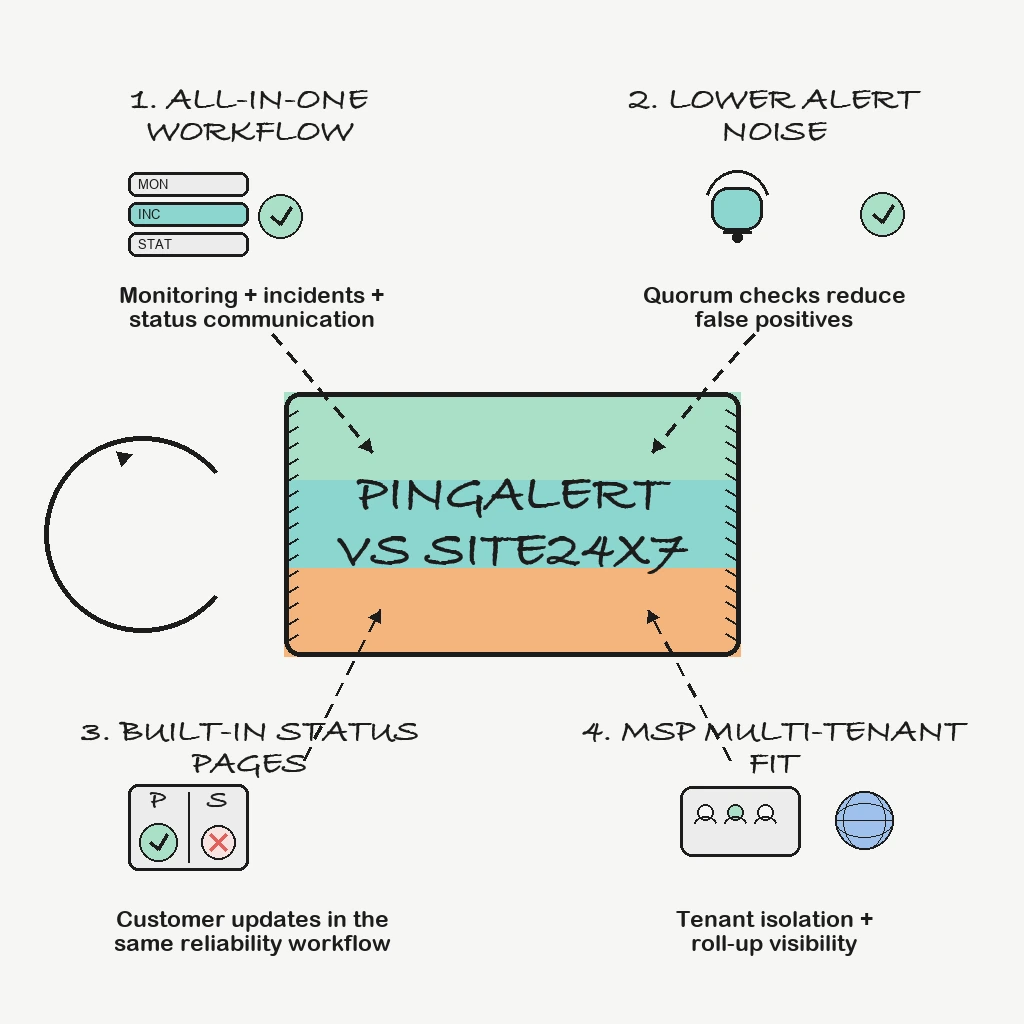
1. Better signal-to-noise for on-call teams
PingAlert emphasizes quorum-style outage confirmation and deduped alerts so responders get fewer false positives and less alert fatigue. That matters when your team is small and every alert interrupts real work.
2. Reliability + communication in one workflow
Many teams can detect incidents, but still struggle to communicate them. PingAlert combines monitoring with incident timelines and status page publishing, so detection, response, and customer updates happen in one place without switching products.
3. Faster customer trust recovery during incidents
With built-in branded status pages and subscriber updates, you can move from "internal firefighting" to "clear external communication" quickly. This reduces support ticket spikes and protects customer confidence.
4. Cleaner fit for MSP and multi-tenant operations
PingAlert is designed for tenant isolation and roll-up visibility, which helps agencies and MSPs manage multiple customer environments without tool sprawl or accidental cross-tenant confusion.
5. Focus over platform sprawl
If your top KPI is uptime reliability and incident handling quality, focused tooling often beats broad tooling. PingAlert prioritizes operational clarity over menu depth, which lowers implementation and handoff complexity.
Where Site24x7 Is Strong
Site24x7 is a solid option when you explicitly want a wider observability footprint in one vendor, including infrastructure and application layers beyond uptime workflows. It also promotes extensive global monitoring coverage and mature synthetic and RUM capabilities.
For teams needing broad, cross-domain observability first, that can be a good fit.
How to Decide
Choose PingAlert when your priority is:
- Lower alert noise and faster acknowledgment
- Better uptime incident workflows
- Built-in, high-trust status communication
- Multi-tenant client operations with simpler day-to-day execution
Choose Site24x7 when your priority is:
- A broad monitoring suite spanning many infrastructure and observability domains
- Consolidation around an all-in-one enterprise monitoring catalog
- Global-capable monitoring with status communication handled through StatusIQ
Reader Questions, Answered
Is PingAlert a Site24x7 alternative?
Yes. PingAlert is a strong Site24x7 alternative for teams that care most about uptime reliability operations, incident response speed, and customer-facing status communication.
What is the biggest difference between PingAlert and Site24x7?
Site24x7 is broad observability and uses StatusIQ for status pages. PingAlert is focused reliability operations for uptime, incidents, and built-in status communication with less operational noise.
Who gets the most value from switching to PingAlert?
SaaS teams, MSPs, and agencies that need calm on-call workflows, fast incident coordination, and clear customer updates without maintaining a large monitoring stack.
Wrap Up
Both platforms can monitor availability. The bigger decision is operational fit.
If your team wants a focused reliability workflow that improves alert quality, response speed, and customer communication, PingAlert is the better-fit path.
Ready to simplify uptime operations and customer communication in one workflow?
Related guides:
- Global website uptime monitoring with PingAlert
- How synthetic monitoring helps
- Mastering uptime for business growth