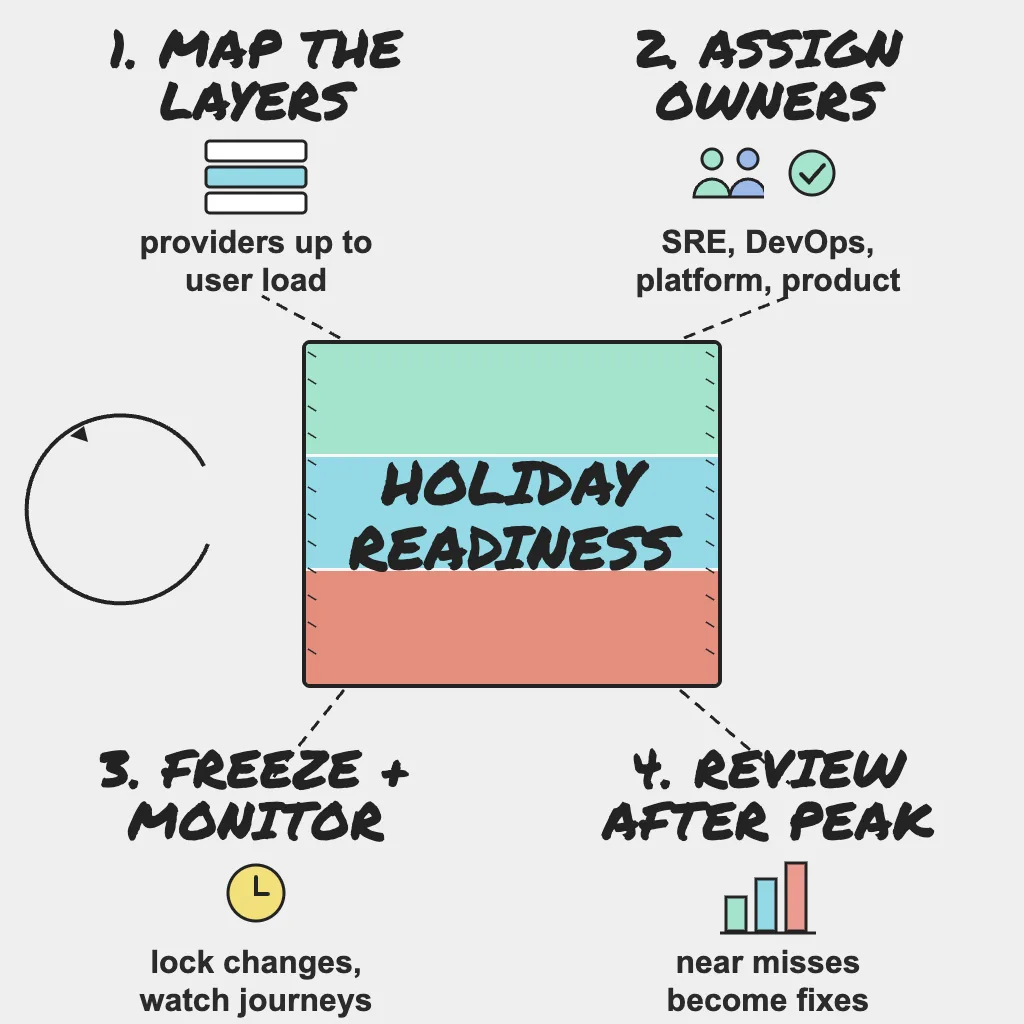
Holiday outages are rarely bad luck. They are a quota nobody raised, a certificate nobody renewed, a provider nobody mapped, or a deploy nobody should have approved, and every one of them was visible weeks earlier to someone who looked. This playbook is the map for the Holiday Readiness series: what to do, in what order, and which team owns it, from six weeks before Black Friday and Cyber Monday (27 and 30 November in 2026) through to the review after the season.
Holiday Readiness series, part 1 of 8. Not sure where to start? Take the free Holiday Readiness Assessment and get a prioritized checklist by email.
Direct Answer
- Start 4 to 6 weeks before your first major sales date. If you have less time, compress the timeline below rather than skipping layers.
- Work up the stack in order: third-party providers, platform limits, changes, detection, people, user load, then the post-peak review.
- Give every area one named owner and agree the split across SRE, DevOps, Platform and Product up front.
- Make the expensive decisions early: which region failure you will survive, how much headroom you will pay for, and which features you will switch off under load.
- After the season, review outages and near misses, and update the checklist for next year.
Why This Matters
Peak season concentrates risk. Traffic and order values are highest, customers are least patient, and many of the people who know the system best are on holiday. A failure that is an annoyance on an ordinary Tuesday becomes a lost sale that rarely comes back.
The other reason is lead time. Quota increases need vendor approval, backup payment providers need contracts, and load tests surface work that takes weeks to fix. Readiness is mostly a scheduling problem: the work is well understood, but it has to start before it feels urgent.
The Readiness Map: Layer by Layer
Each layer depends on the one below it. A perfect on-call rotation cannot save a checkout whose payment provider is down with no fallback. Work from the bottom up.
- Part 2, providers: When third-party providers fail at peak. Map every external dependency, from cloud region and DNS to payments and identity, decide what checkout does when each fails, test fallbacks, and renew everything that expires before January.
- Part 3, platform limits: Capacity: quotas, connection limits and rate limits. Find the ceilings before traffic does: cloud quotas, autoscaling maximums and warm-up, connection pools, rate limits, queue throughput, and a backup you have actually restored.
- Part 4, changes: Change freeze and release safety. Announce freeze dates, define critical fixes and approvers, require tested rollbacks, treat configuration as change, and use feature flags as kill switches.
- Part 5, detection: Holiday website monitoring checklist. Monitor what customers experience: multi-region uptime, multi-step checks on revenue flows, response-time thresholds, SSL, domain and DNS checks, heartbeats for background jobs, and tested, severity-routed alerts.
- Part 6, people: On-call, runbooks and incident communication. Staff the peak fairly with backups, write short runbooks, give clear authority to fail over or switch features off, and prepare a status page and message templates.
- Part 7, user load: Unexpected traffic: load testing and graceful degradation. Load test the full journey at 2 to 3x last year's peak, plan for flash sales and bots, keep a waiting room ready, and decide in advance which features go dark so checkout stays up.
- Part 8, review: After the peak: post-incident reviews. Run blameless reviews, mine monitoring data for near misses, assign actions with owners and dates, unwind the freeze safely, and update the checklist.
The Timeline: Six Weeks Out to Post-Season
Count backwards from your first major sales date, not from the calendar. If your peak is a product launch or an end-of-year billing run, the same rhythm applies.
| When | Focus | Done when |
|---|---|---|
| 6 weeks out | Inventory and big decisions | Dependency map, expiry audit, region failure decision, headroom budget, owners named |
| 5 weeks out | Limits and load | Quota increases requested, first full-journey load test run, fixes scheduled |
| 4 weeks out | Fallbacks and recovery | Backup restore rehearsed, provider fallbacks tested, second load test passed |
| 3 weeks out | Detection and people | Multi-step checks and heartbeats live, severity levels set, on-call schedule published, runbooks drafted |
| 2 weeks out | Soft freeze and rehearsal | Feature work stopped, kill switches tested, status page and templates ready, failover rehearsed |
| 1 week out | Hard freeze and final checks | Critical fixes only, test alerts confirmed by every contact, pre-scaling in place, staffing confirmed |
| Peak days | Watch and respond | Incident channel open, daily check-ins, every decision and flag change logged |
| Through last shipping cutoff | Hold the line | Freeze kept, batch jobs and order exports watched |
| Post-season | Review and recover | Freeze unwound in stages, reviews held, checklist updated, people rested |
Two things in that table deserve early attention.
Decide your regional failure plan in October
Regional disaster recovery is a decision you make in October, not during Black Friday. Know which failures you will survive (a zone, a region, a provider) and which you will ride out with a status page update. Both are legitimate answers. The only wrong answer is discovering which one you chose while it is happening.
Agree the headroom budget up front
Pre-scaling, over-provisioning and raised plan tiers cost money, and so do usage-billed third parties (SMS, email, fraud screening, AI features) whose bills rise with traffic. Agree the peak budget with finance and product before the season.
Field note: Clear reasoning beats heroics. The best peak seasons are boring, and boring is designed: a team that can say why each risk is accepted, mitigated or deferred will outperform a team whose plan is to work harder on the day.
Make Readiness a Paved Road
The teams that cope best do not treat peak season as a November project. Readiness is an operating rhythm, and the platform team makes the right thing the easy thing: a standard set of monitors per critical service, a heartbeat for every scheduled job, a runbook template, a dependency register, and freeze gates in the deploy pipeline. A team that ships a new service in October should inherit holiday-grade monitoring without filing a ticket.
Three things are easy to miss:
- Peak traffic is also peak data. Order exports, inventory syncs and reconciliation jobs compete with live traffic. Schedule and throttle them, and watch them with heartbeats so the back office does not take down the front office.
- Test recovery time, not just steady state. How long does a pod take to boot and warm its caches, or a database to fail over? A system that holds peak load but recovers slowly from a restart is not ready.
- Prepare the evidence before the call. Escalations go well when the runbook, the owner and the evidence (monitors, logs, incident timelines) exist before anyone is paged.
PingAlert can carry part of that paved road: multi-region uptime checks with confirmation, multi-step checks on revenue flows, SSL certificate monitoring, heartbeat monitors for cron jobs, and alert routing to Slack, Teams, email, SMS or webhooks.
Field note: Disciplined execution beats brilliance at 3am. A plan with named owners, dates and a weekly check-in is worth more than an elegant architecture diagram, because peak season punishes unowned work, not missing skill.
Who Owns What
Every area needs one named owner. Shared ownership at 3am means no ownership.
- SRE: Defines critical journeys and alert severity, owns external monitoring and test alerts, runs the on-call rotation and incident lead role, and facilitates post-peak reviews.
- DevOps: Owns the freeze calendar and deploy gates, runs the exception process, verifies rollback plans, and keeps configuration under version control.
- Platform: Owns quotas, autoscaling, connection pools, backups and restore, regional failover and provider integrations at the infrastructure level (DNS, CDN, cloud), and the paved-road defaults other teams inherit.
- Product: Ranks journeys by business value, decides which features degrade or switch off under load, approves business-driven freeze exceptions and provider fallbacks, owns customer messaging, and signs off the headroom budget.
Practical Checklist
- Fix your peak dates, including the last shipping cutoff, and count back 6 weeks.
- Name one owner for each layer of the readiness map and one overall readiness owner.
- Map third-party dependencies and audit everything that expires before January.
- Decide which regional or provider failures you will survive and which you will ride out.
- Agree the peak headroom budget, including usage-billed third parties.
- Request quota increases, run full-journey load tests, rehearse a restore and test provider fallbacks.
- Put multi-step monitoring, heartbeats and tested, severity-routed alerts in place.
- Publish the on-call schedule with backups, runbooks and decision authority.
- Start the soft freeze, test kill switches, and prepare the status page and templates.
- Move to a hard freeze, confirm test alerts and staffing, and pre-scale.
- After the season, unwind the freeze in stages, review outages and near misses, and update this checklist.
Reader Questions, Answered
When should we start preparing for holiday traffic?
Four to six weeks before your first major sales date. That leaves time to load test, fix what you find, and get quota increases and provider contracts approved before the freeze.
What if we have only two weeks left?
Prioritize the items that are cheap and catch the most avoidable outages: the expiry audit, multi-step monitoring on checkout and payment, tested alerts, a published on-call schedule, and a firm change freeze.
Does this playbook apply to B2B SaaS, not just e-commerce?
Yes. Your peak is whenever your customers' peak is, such as end-of-year billing, reporting deadlines or a launch. The layers, timeline and ownership model are the same.
Who should own the overall readiness plan?
One named person, often an SRE or platform lead, who tracks the checklist and chases owners. They coordinate the plan; each layer still has its own owner.
Wrap Up
Peak-season reliability is not a heroic weekend. It is six weeks of unglamorous, scheduled work, done bottom-up by teams who know what they own, followed by an honest review. Start with the layer you are least sure about. Take the Holiday Readiness Assessment to find out which one that is.
Holiday Readiness Series
- The peak-season reliability playbook (you are here)
- When third-party providers fail at peak
- Capacity: quotas, connection limits and rate limits
- Change freeze and release safety
- Holiday website monitoring checklist
- On-call, runbooks and incident communication
- Unexpected traffic: load testing and graceful degradation
- After the peak: post-incident reviews
Next: When third-party providers fail at peak
Related guides:
- Website and API uptime monitoring: what to monitor first
- Incident management workflow: the first 30 minutes
- Status page best practices for customer trust
Sources and references
- This post is based on PingAlert's holiday readiness checklist and holiday website monitoring guidance.
- Google SRE Book
- Google SRE Workbook