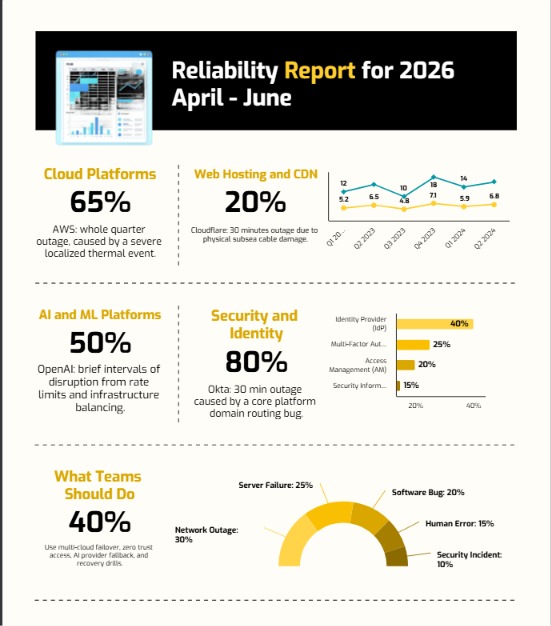
Q2 2026 reinforced a point that strong teams already suspect but do not always operationalize: reliability risk does not stay inside one vendor category. The attached April through June 2026 reliability summary highlighted disruption across cloud platforms, web hosting and CDN infrastructure, AI and ML platforms, and security and identity systems. That spread matters because most teams now depend on all four at once.
Direct Answer
The clearest lesson from Q2 2026 is that outage preparedness has to be broader than uptime checks on your own application. Teams should assume that cloud failures, routing issues, software bugs, and human error can interrupt upstream providers at any time, then build for faster detection, faster communication, and faster recovery through multi-channel alerts, defined escalation paths, failover testing, and well-maintained public status pages.
Why This Matters
The operational risk is no longer only "will our app go down?" It is also:
- which provider fails first
- how quickly the team detects that failure
- whether internal responders get the alert through a backup path
- whether customers receive a clear update before confusion spreads
When any one of those breaks, the outage becomes harder to manage than it needed to be.
Q2 2026 by the Report Summary
The attached reliability graphic emphasized four categories:
- Cloud platforms: 65% in the report summary, with AWS called out for a quarter outage tied to a severe localized thermal event
- Web hosting and CDN: 20% in the report summary, with Cloudflare noted for a 30-minute outage related to physical subsea cable damage
- AI and ML platforms: 50% in the report summary, with OpenAI described as seeing brief intervals of disruption from rate limits and infrastructure balancing
- Security and identity: 80% in the report summary, with Okta noted for a 30-minute outage caused by a core platform domain routing bug
Even in summary form, the signal is useful: reliability exposure is distributed across the infrastructure layers teams rely on every day.
The Biggest Patterns Behind Q2 2026 Outages
Cloud and infrastructure failures still create the broadest blast radius
Cloud incidents remain especially dangerous because they can affect multiple dependent systems at once. When core platform capacity, regional infrastructure, or physical operating conditions degrade, the downstream symptoms can look like application bugs even when the root cause sits upstream.
Routing and network issues create confusing failures
The summary called out both CDN and identity routing problems. These incidents are operationally messy because they often look partial at first: some users can log in, some requests succeed, some regions look normal, and internal teams waste time validating the wrong layer.
AI platforms now belong in production reliability planning
The Q2 2026 summary treated AI and ML providers as real operational dependencies, not side tools. That is the right framing. If teams rely on external models for support flows, content operations, engineering workflows, or customer-facing features, AI disruption now belongs in the same incident planning category as cloud and identity dependencies.
Human error and software bugs are still core failure modes
The graphic's cause breakdown is a practical reminder that not every outage starts with a dramatic infrastructure event. It assigned:
- Network outages: 30%
- Server failures: 25%
- Software bugs: 20%
- Human error: 15%
- Security incidents: 10%
That distribution argues against overfitting reliability planning to one outage story. Teams need playbooks that work across infrastructure, routing, code, and operational mistakes.
What Teams Should Change Now
The attached summary already points to the right response model. Teams should turn that into operating practice:
- Set up multi-channel alerts. Do not depend on a single notification path such as email, one chat tool, or one incident platform.
- Define escalation clearly before the next incident. Make it obvious who validates the signal, who owns technical response, and who publishes customer-facing updates.
- Run regular failover tests. Backup paths are only useful if the team has already proven they work under pressure.
- Keep public status pages current. Customers should not have to infer what is happening from scattered support messages.
- Review single-provider concentration risk. If one cloud, identity, or AI dependency can halt critical workflows, document the fallback plan explicitly.
This is closely aligned with the operating discipline outlined in status page incident communication workflow: what to publish in the first 60 minutes and how synthetic monitoring helps and why it is important.
Reader Questions, Answered
What was the main lesson from Q2 2026?
That reliability planning has to cover cloud, hosting, AI, and identity dependencies together. Teams cannot assume one provider category is the only serious failure point.
Why are multi-channel alerts so important?
Because an incident is harder to manage when the primary alert path fails at the same time as the underlying service. Backup channels reduce the chance of silent detection delays.
Why should public status pages be part of outage planning?
Because reliability is also a communication problem. A current status page helps customers understand impact, follow progress, and avoid unnecessary confusion during active incidents.
What should teams test after reading this report?
Test alert delivery redundancy, escalation timing, failover paths, and status-page publishing speed. Those are the controls most likely to shorten the next incident.
Wrap Up
Q2 2026 did not point to one single outage story. It pointed to a pattern: cloud failures, routing issues, software bugs, and human error can all trigger customer-facing disruption across the providers teams rely on most.
Reliability is not only about preventing outages. It is about detecting them quickly, communicating clearly, and recovering with less confusion. Teams that build those muscles before the next quarter will handle provider incidents far better than teams that only hope for fewer outages.
Ready to improve monitoring, incident response, and customer communication in one workflow?
Related guides:
- Q1 2026 infrastructure reliability report
- How synthetic monitoring helps and why it is important
- Website, API, and uptime monitoring priority checklist
Sources and references
- Attached
Reliability Report for 2026 April - Juneinfographic provided by the user as the primary source for the Q2 2026 summary figures and example incidents. - User-provided summary text describing Q2 2026 outage lessons around cloud, hosting, AI, identity, multi-channel alerting, escalation, failover testing, and public status communication.