Better Stack is one of the most complete platforms in this space. Uptime checks, on-call, incident management in Slack and Teams, status pages, logs, metrics, traces and real user monitoring all live under one roof. For a product engineering team, that breadth is the point. For an agency running monitoring for 20 clients, breadth is not the question. The question is how the tool maps to clients, and what each extra client costs.
This guide compares Better Stack and PingAlert through that agency lens. Every Better Stack fact comes from Better Stack's own pricing, status page and documentation pages in November 2026, linked at the end.
Direct Answer
Choose Better Stack if you want one vendor for uptime, on-call with phone alerts, incident workflows and full telemetry, and you are comfortable with per-responder licensing plus status page add-ons. Choose PingAlert if your core job is uptime, API and SSL monitoring for many clients, with each client in its own workspace, white-label status pages with custom domains on paid plans, and flat monthly tiers that are easy to price into a retainer.
Why This Matters
Agencies resell outcomes, not tools. Your margin on a monitoring retainer depends on two numbers you can predict: what the tooling costs per client, and how much staff time each client consumes. A platform priced around responders and per-page add-ons can be excellent value for one product team and harder to model across a client portfolio. Neither model is wrong. You just need to run the numbers at your real client count before you commit.
What Better Stack Does Well
- Breadth in one platform: As listed on Better Stack's pricing page in November 2026, the platform covers uptime monitoring, Playwright-based transaction monitoring, heartbeats, on-call scheduling, incident management, status pages and telemetry (logs, metrics, traces, errors and real user monitoring).
- Strong alerting: The responder license includes unlimited phone call and SMS alerts, and the uptime section lists email, push notifications, Slack, Microsoft Teams, webhooks and Zapier.
- Fast, verified checks: The pricing page lists up to 30-second check frequency, multi-location and geo-specific checks, multi-step incident verification, screenshots of errors, maintenance windows and uptime SLA reporting.
- Wide check coverage: SSL, DNS server, ping, TCP and UDP port, POP3, IMAP and SMTP, plus TLD expiration monitoring.
- Generous team access: The pricing page lists unlimited team members at $0 per member with free access to telemetry, while responders who handle incidents need a paid license.
- Branded status pages on your domain: Better Stack's status page product page describes a branded page on your own subdomain set up with "a single CNAME record."
- Multiple teams: Better Stack's documentation describes creating additional teams from the Teams section.
Pricing Shape for an Agency
As listed on Better Stack's pricing page in November 2026, the free plan is described as "Free for personal projects" and includes 10 monitors and heartbeats, one status page, and Slack and email alerts. Paid usage starts with a responder license at $34 per month on monthly billing ($29 per month billed annually). The uptime section lists 10 monitors included, with additional blocks of 50 monitors at $25 per month ($21 billed annually).
Status pages are where agency math gets interesting. One status page is included. Each additional public status page is $15 per month ($12 billed annually). White-labeling, defined on the page as removing the "Powered by Better Stack" footer, is $250 per page per month ($208 billed annually). Password protection is $50 per page per month and sending subscriber emails from your own domain is $250 per page per month. Reporting and analytics are $5 per member per month.
To be fair: many agencies will be happy with a branded subdomain page and never need the footer removed. But if your contracts promise fully white-label pages for every client, multiply that line item by your client count before you sign.
Field note: Price your tooling at the client count you expect in two years, not the one you have today. Per-page and per-seat pricing is perfectly fair, but someone has to defend it in every margin review, so agree the budget before the clients arrive.
Agency Comparison at a Glance
| Capability | Better Stack | PingAlert |
|---|---|---|
| Separate client spaces | Multiple teams (per docs) | Client workspaces (3 on Professional, 10 on Business) |
| Branded status page on your domain | Yes | Paid plans |
| Remove vendor branding | Paid add-on per page | Included on paid plans |
| Fastest listed check interval | Up to 30 seconds | About 30 seconds (Professional, Business) |
| Phone call alerts | Yes | No (SMS, email, chat, webhooks) |
| Slack, Teams and webhooks | Yes | Yes |
| On-call scheduling | Yes | Escalation policies and quiet hours |
| Real browser (Playwright) checks | Yes | No (multi-step API checks) |
| Logs, metrics and traces | Yes | No |
| Pricing model | Per responder license plus add-ons | Flat monthly tiers |
Where PingAlert Fits Agencies Differently
PingAlert deliberately does less, and organizes what it does around clients.
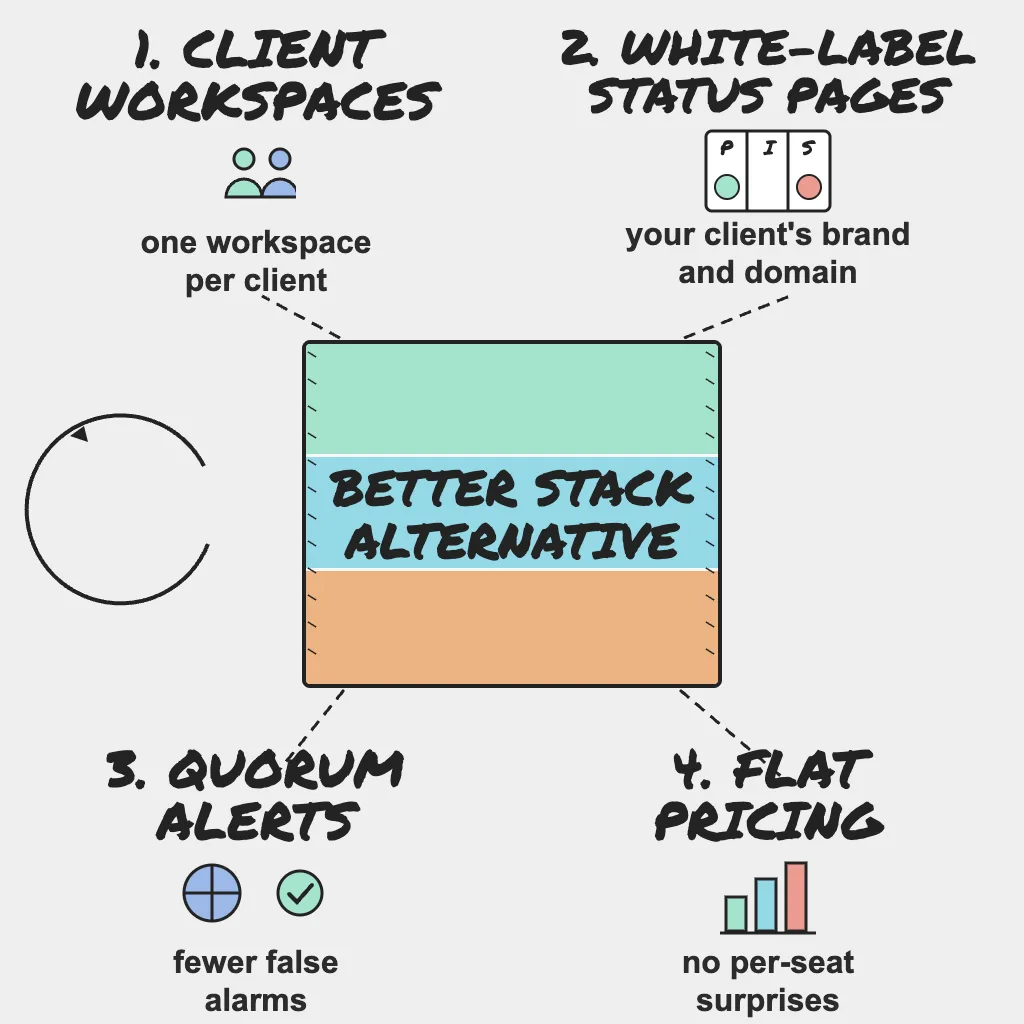
- Client workspaces: Each client's monitors, alerts, incidents and status pages are kept separate under one subscription, with a portfolio view of client health and active incidents across all of them. See how this works on the agencies page.
- Monitor templates: Onboard a new client from a template so every site gets the same baseline of uptime, SSL, DNS and keyword checks.
- Low-noise detection: Multi-region checks with quorum-based confirmation, deduplicated notifications, escalation policies, quiet hours, alert rules and maintenance windows.
- White-label status pages: Branded status pages with custom domains on paid plans, subscriber notifications, incident timelines and incident templates.
- API depth without a browser fleet: API checks with custom methods, headers and bodies, and multi-step API checks that chain requests for login, cart and checkout flows.
- Flat tiers: Starter at $29 per month (25 monitors, 2-minute checks, 3 regions, 1 branded status page), Professional at $79 (75 monitors, about 30-second checks, 5 regions, 3 client workspaces) and Business at $249 (300 monitors, about 30-second checks, 10 regions, 10 client workspaces). Details are on pricing.
When to Stay with Better Stack
- You need full observability. If your agency also manages client infrastructure and wants logs, traces and metrics next to uptime, Better Stack covers that and PingAlert does not.
- You rely on real browser checks. Better Stack offers Playwright-based transaction monitoring. PingAlert offers multi-step API checks, not browser scripting.
- Phone call alerting and on-call calendars are central to how your team responds at night.
- You monitor domain registrations. Better Stack lists TLD expiration monitoring; PingAlert does not offer domain expiry checks.
- Your status page needs are light. If a branded subdomain page with the standard footer is fine for your clients, the add-on costs may never apply.
How to Switch Without a Monitoring Gap
Start by listing what each client needs, not what the old tool happened to have. The free uptime monitoring requirements checklist gives you a one-page baseline per client.
- Export your monitors. Better Stack's pricing page lists a REST API and a Terraform provider. Use either to pull every monitor with its URL, type, frequency, regions and alert policy, grouped by team or client.
- Recreate checks per client. Create one PingAlert workspace per client, apply a monitor template, then add client-specific checks. Map heartbeats to heartbeat monitors, keyword checks to keyword checks, and decide where a multi-step API check replaces a browser flow.
- Map alert channels. Recreate Slack, Teams, email, SMS and webhook routes per client. Where you relied on phone calls, decide on SMS plus escalation policies, or keep an on-call tool that receives PingAlert webhooks.
- Rebuild status pages. Recreate components, branding and subscriber lists, and prepare the custom domain CNAME change without switching it yet.
- Run both in parallel for a week. Compare alerts side by side, investigate any mismatch, then move status page domains and retire the old monitors.
Reader Questions, Answered
Is Better Stack good for agencies?
Yes, especially agencies that also run client infrastructure and want telemetry, on-call and incidents in one platform. Model responder licenses and per-page status page add-ons against your client count first.
How much does white-labeling a Better Stack status page cost?
As listed on Better Stack's pricing page in November 2026, removing the "Powered by Better Stack" footer is $250 per page per month on monthly billing, or $208 per page per month billed annually.
Can PingAlert replace Better Stack's logs and traces?
No. PingAlert focuses on uptime, API, SSL, DNS, multi-step and heartbeat monitoring, incidents and status pages. If you need logs or tracing, keep a dedicated tool for that.
Do I lose phone call alerts if I switch?
PingAlert alerts through Slack, Microsoft Teams, Discord, email, SMS and webhooks. If phone calls are a hard requirement, route PingAlert webhooks into an on-call tool that places calls.
Wrap Up
Better Stack is a powerful platform, and for teams that want everything in one place it earns its price. Agencies have a narrower, sharper need: every client separated, every client branded, and a cost that scales the way retainers do. If that is your shape, compare tiers on pricing and run the requirements checklist before you decide.
Related guides: