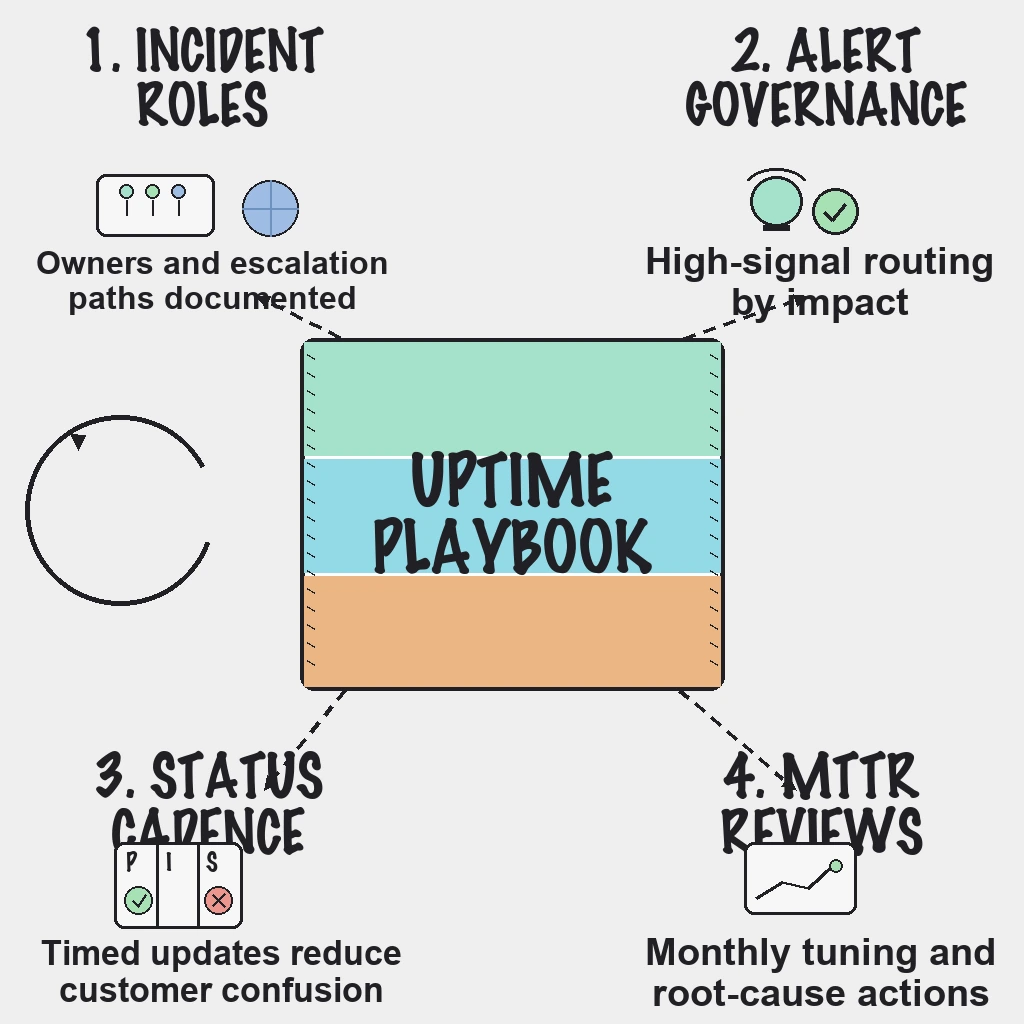
Teams often ask how to improve uptime reliability without adopting a heavy observability stack too early. In practice, the fastest gains come from better monitoring coverage, cleaner alert routing, and disciplined incident communication.
Quick Answer
Use a monitoring-first workflow:
- Monitor customer-critical website and API endpoints.
- Route alerts by severity and explicit ownership.
- Publish status updates on a fixed incident cadence.
- Track MTTD and MTTR by incident type and service area.
Why Reliability Programs Stall
Most teams do not fail on tooling first. They fail on operating consistency:
- No clear incident ownership by service.
- Alerts mixed across high-impact and low-impact issues.
- Status communication handled ad hoc in chat.
- Follow-up tasks not tracked after resolution.
Monitoring-First Workflow
1. Prioritize high-signal checks
Start with endpoints tied directly to customer outcomes:
- Homepage and login
- Core API health
- Revenue-critical transaction path
- SSL certificate and domain validity
2. Route by impact and ownership
Define severity paths before incidents:
- P1: Customer-facing outage, immediate on-call page
- P2: Partial degradation, urgent team channel escalation
- P3: Low-impact warning, business-hours review
3. Keep communication on schedule
Post public status updates on a fixed cadence (for example every 20-30 minutes) until full recovery.
4. Measure and tune monthly
Track:
- MTTD and MTTA
- MTTR by incident category
- False-positive alert rate
- Time to first public update
7-Step Action Checklist
- Document incident roles and escalation owners.
- Build customer update templates.
- Separate critical alerts from noisy alerts.
- Write runbooks for high-risk services.
- Run response drills quarterly.
- Publish concise post-incident timelines.
- Review recurring root causes monthly.
Reader Questions, Answered
What should every status page update include?
Impact summary, affected components, mitigation progress, and next update ETA.
How often should teams update during incidents?
Use fixed time-based updates, usually every 20-30 minutes for major incidents.
What is the best way to reduce alert fatigue?
Focus paging on service-impacting alerts, add deduplication, and assign ownership per monitor.
Wrap Up
Reliable uptime is mostly an operations discipline: focused monitoring, clear alert governance, and predictable communication.
Ready to run uptime reliability with less noise and faster incident recovery?
Related guides:
- Incident management workflow for SaaS
- Website and API uptime monitoring priorities
- Status page best practices for customer trust